How Our AI Meal Plan Generator Calculates Daily Macronutrients
A transparent technical breakdown of the multi-stage algorithms, biometric equations, and Atwater partitioning rules powering our AI meal plan generator.
Key Takeaways
- Our meal generator operates on a deterministic 4-stage calculation pipeline: BMR baseline -> PAL expansion -> Goal delta -> Atwater macro balancing.
- Caloric scaling uses exact Atwater multipliers (4 kcal/g protein, 4 kcal/g carbs, 9 kcal/g fat) to eliminate rounding discrepancies across daily totals.
- Regional recipe libraries are dynamically calibrated against local purchasing power parities and culturally authentic ingredient distributions.
- You can verify every formula independently on our [Calculation Methodology](/methodology) page or use our standalone [Macro Calculator](/calculators/macro).
1. The 4-Stage Algorithmic Architecture
Unlike generic chat tools that generate unpredictable recipes with fictitious nutritional numbers, GoDietPlan operates on a strictly bound, mathematical constraint pipeline. The generation engine combines deterministic physiological equations with intelligent recipe composition.
Every 7-day meal plan passes through four sequential phases: Biometric Calibration, Energy Target Formulation, Macronutrient Boundary Allocation, and Recipe Portfolio Matching with localized price anchoring.
2. Stage 1 & 2: Basal Metabolic Rate and Energy Scaling
In Stage 1, the user's raw biometrics (age, weight, height, biological sex) are evaluated through the Mifflin-St Jeor formula to determine the resting BMR floor. Next, the user's Physical Activity Level (PAL) multiplier (from 1.200 to 1.900) is applied to establish total maintenance energy.
In Stage 2, the algorithm applies the goal-specific caloric delta: A safe 15% to 20% deficit for fat reduction (enforcing a strict 1,200 kcal safety floor), 0% for maintenance, or a 10% to 15% surplus for lean mass building. Users can test these exact calculations using our BMR Calculator and TDEE Calculator.
3. Stage 3: The Atwater General Factor Macro Distribution
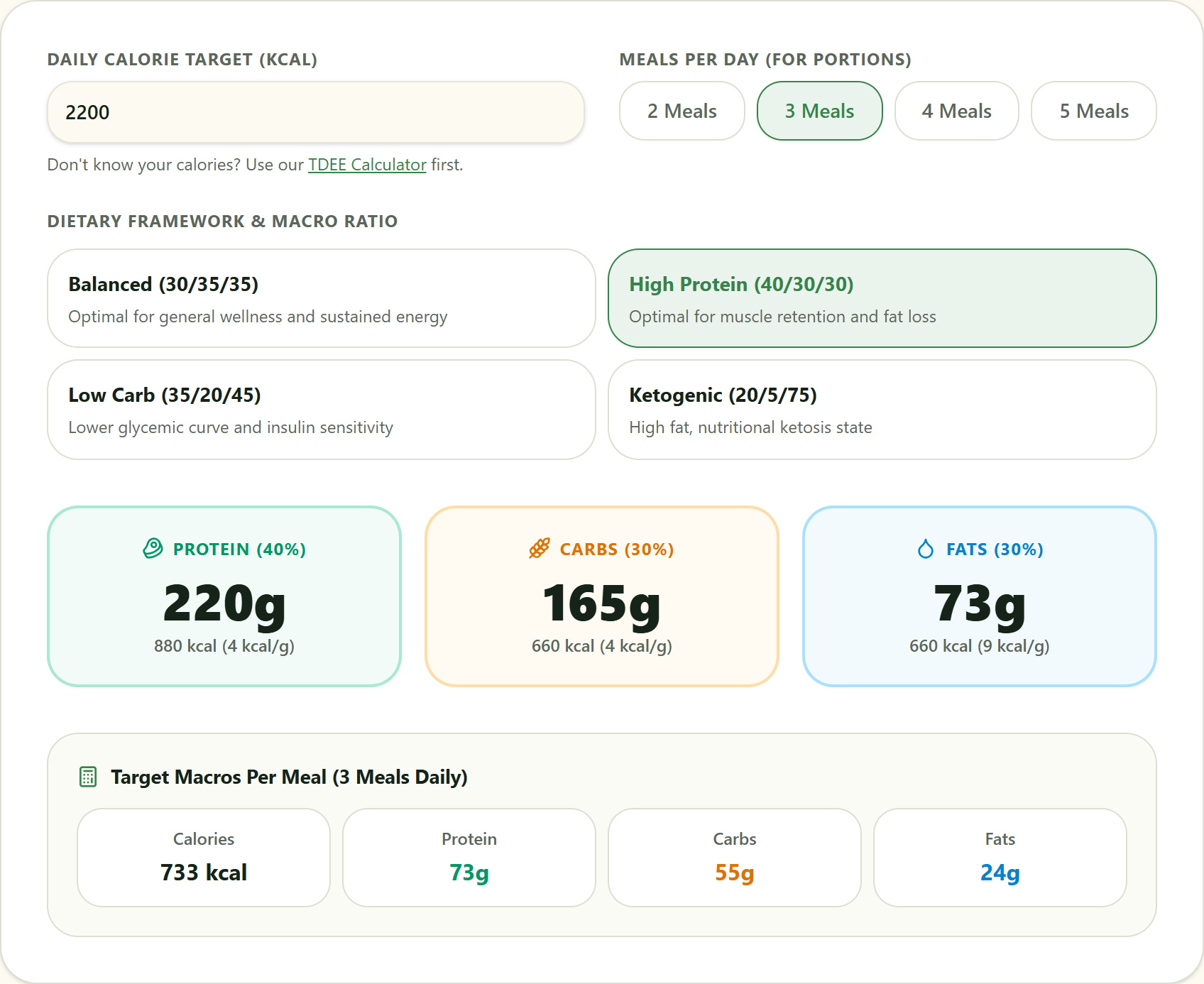
Once the target daily calorie ceiling is established, Stage 3 allocates energy across the three primary macronutrients according to validated physiological ranges:
1. Protein Allocation: Scaled according to goal demand (1.6g to 2.2g per kg of body weight for deficit and muscle gain goals) at 4 kcal per gram.
2. Lipid Allocation: Guarded with a baseline floor of 20% to 30% of total daily energy at 9 kcal per gram to ensure fat-soluble vitamin transport and cellular health.
3. Carbohydrate Allocation: The remaining caloric balance is designated to complex carbohydrates at 4 kcal per gram to sustain glycogen storage and daily cognitive energy.
You can simulate custom macro distributions using our interactive Macro Calculator.
| Fitness Goal | Protein % Range | Carbohydrates % Range | Fats % Range | Primary Physiological Function |
|---|---|---|---|---|
| Fat Loss / Deficit | 35% – 40% | 30% – 35% | 25% – 30% | Satiety elevation & muscle retention |
| Weight Maintenance | 25% – 30% | 40% – 50% | 25% – 30% | Energy balance & glycogen replenishment |
| Muscle Hypertrophy | 30% – 35% | 45% – 50% | 20% – 25% | Surplus partitioning & muscle growth |
| Athletic Endurance | 20% – 25% | 55% – 60% | 20% – 25% | High glycolytic turnover & stamina |
4. Stage 4: Combinatorial Meal Matching and Price Normalization
In the final stage, the engine selects meals from localized cuisine repositories that conform to the target calorie and macro allocations. Each meal's ingredients are matched against local purchasing power parities (PPP) to produce authentic recipes with realistic regional grocery estimates.
If a daily total drifts slightly from the calculated target, a proportional scaling coefficient is applied to the ingredient serving weights, ensuring that the sum of breakfast, lunch, dinner, and snacks matches the computed target within a +/- 2% margin.
5. Experience the Algorithm in Action
Ready to see the calculation engine build a complete 7-day schedule for your exact profile? Launch our Free AI Meal Plan Generator to receive instant recipes, portions, and estimated grocery costs tailored to your home currency, or test custom ratios with our Macro Calculator.
Frequently Asked Questions
Why do daily calories on my generated plan sometimes differ by 20–30 kcal from the target?
Whole food ingredients have natural discrete serving bounds. When scaling real ingredients (e.g. whole eggs or whole pieces of fruit), minor rounding of 1% to 2% occurs to maintain realistic kitchen cooking practicality.
Can I manually override the target calories in the generator?
Yes. On Step 1 of the generator form, you can enter a custom calorie number if you have specific dietary targets.
How are grocery prices estimated in my local currency?
Our engine maps standard raw dry ingredients against localized Purchasing Power Parity (PPP) indices and typical regional market averages for low, medium, and high budget tiers.
Scientific Evidence & References
- Energy and Macronutrient Requirements: Mathematical Modeling of Human Metabolism — Annual Review of Nutrition, 34, 17–36[View Source ]
- The Atwater System of Energy Equivalents: Historical and Contemporary Applications — Journal of Nutrition, 136(6), 1668S–1674S[View Source ]
Generate Your Custom 7-Day Plan
Apply these principles to your local groceries, budget, cuisine, and fitness goal in seconds.
Open 7-Day Meal Generator