Understanding the Math Behind the Mifflin-St Jeor BMR Equation
A deep dive into the mathematical coefficients, physiological derivation, and comparative accuracy of the Mifflin-St Jeor Basal Metabolic Rate formula.
Key Takeaways
- The Mifflin-St Jeor equation predicts resting energy expenditure with a standard statistical error of +/- 10%, outperforming older 20th-century models.
- The equation's coefficients (10 per kg body mass, 6.25 per cm height, -5 per year of age) represent standardized thermodynamic heat production vectors.
- Biological sex constants (+5 for males, -161 for females) reflect baseline population variances in average skeletal muscle mass and organ weight proportions.
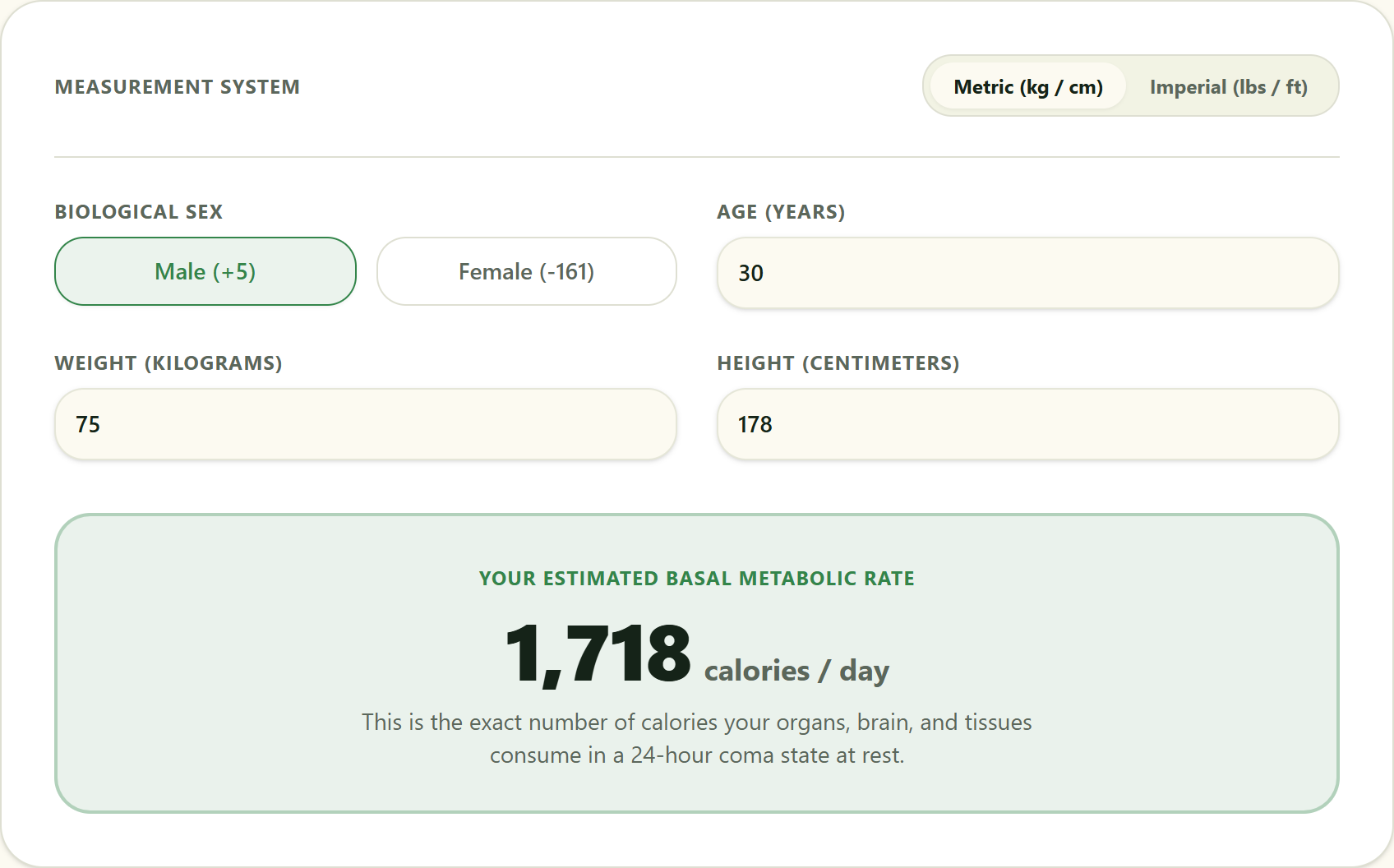
- Try your own biometrics in our dedicated [BMR Calculator](/calculators/bmr) to see the exact formula executed in real time.
1. The Evolution of Basal Metabolic Rate Estimation
Basal Metabolic Rate (BMR) represents the foundational energetic cost of human biological existence—the volume of kilocalories required to maintain organ homeostasis, cellular membrane potentials, sodium-potassium pumps, and respiratory mechanics at complete rest.
For decades, the standard formula was the Harris-Benedict equation (formulated in 1919). However, changes in modern human height-to-weight distributions and body composition made the original 1919 formula systematically overestimate energy requirements by 5% to 15%. In 1990, Dr. M. D. Mifflin and Dr. S. T. St Jeor published a revised predictive model in the American Journal of Clinical Nutrition that remains the gold standard of non-invasive metabolic calculation.
2. Deconstructing the Mathematical Coefficients
The Mifflin-St Jeor equation relies on four distinct variables: Weight in kilograms (W), Height in centimeters (H), Age in solar years (A), and a biological sex constant (s):
BMR = (10 × W) + (6.25 × H) - (5 × A) + s
Where s = +5 for males, and s = -161 for females. Each coefficient has a direct physiological underpinning:
1. 10 × Weight (kg): Every kilogram of total body mass expends approximately 10 kilocalories daily merely maintaining basic tissue respiration and thermal equilibrium.
2. 6.25 × Height (cm): Height serves as a surrogate for total anatomical surface area and vascular network length. Taller individuals exhibit greater radiant heat loss and capillary volume, requiring 6.25 kcal per centimeter.
3. -5 × Age (Years): Due to natural mitochondrial efficiency shifts and gradual declines in muscle mass over decades, baseline metabolism drops by approximately 5 kilocalories per day for every elapsed year of life.
4. Gender Modifier (+5 vs. -161): Accounting for the average phenotypic difference in essential adipose tissue (12% in females vs. 3% in males) and lean visceral organ mass.
3. Equation Sensitivity & Variable Impact Analysis
To understand how each personal biometric alters your baseline caloric burn, consider how adjusting individual variables shifts the final BMR output. A 10 kg alteration in body weight shifts daily BMR by exactly 100 kcal, whereas a 10 cm shift in height alters BMR by 62.5 kcal. Age produces a gradual decline of 50 kcal per decade.
Explore your personal sensitivity and baseline energy floor on our BMR Calculator, or calculate your total daily movement burn via our TDEE Calculator.
| Biometric Variable | Incremental Delta | Daily BMR Impact | Annual Energetic Equivalent |
|---|---|---|---|
| Body Weight (W) | +5 kg | +50 kcal / day | +18,250 kcal / year |
| Body Weight (W) | -10 kg | -100 kcal / day | -36,500 kcal / year |
| Height (H) | +8 cm | +50 kcal / day | +18,250 kcal / year |
| Age (A) | +10 years | -50 kcal / day | -18,250 kcal / year |
| Age (A) | +20 years | -100 kcal / day | -36,500 kcal / year |
| Biological Sex Constant | Male (+5) vs Female (-161) | 166 kcal differential | Baseline lean mass variance |
4. Accuracy Bounds and Indirect Calorimetry Comparison
In validation studies conducted across diverse cohorts, the Mifflin-St Jeor formula accurately predicts resting metabolic rate within +/- 10% of indirect calorimetry (the gold-standard laboratory measurement using gas exchange analysis) for over 82% of individuals.
Variance occurs primarily in extreme athletic populations with exceptionally high muscle mass (where BMR is slightly underestimated) or individuals with high body fat percentages (where BMR is slightly overestimated). For the vast majority of healthy adults, the formula provides an exceptionally reliable foundation for dietary planning.
5. Converting BMR into a Practical Nutrition Plan
Once your baseline BMR is established, it is combined with FAO/WHO physical activity multipliers to derive your Total Daily Energy Expenditure. From there, you can apply an evidence-based 15% to 20% deficit using our Calorie Deficit Calculator or allocate macros using our Macro Calculator.
You can test your own numbers in our interactive BMR Calculator or read our complete mathematical specification and literature citations on our Calculation Methodology page.
Frequently Asked Questions
Why does the female formula have a -161 constant while the male formula has +5?
The -161 constant reflects the biological reality that women naturally maintain a higher percentage of essential adipose tissue (which is metabolically less active than skeletal muscle tissue) to support reproductive endocrinology.
Does BMR decrease permanently when dieting?
A temporary reduction in BMR occurs during weight loss due to decreased total body mass and adaptive thermogenesis. However, consuming adequate protein and avoiding extreme deficits (>25%) preserves lean mass and keeps metabolic adaptation within normal physiological bounds.
How often should I recalculate my BMR?
Recalculate your BMR whenever your body weight changes by 3 to 5 kilograms, or every 6 to 12 months as part of routine nutritional planning.
Scientific Evidence & References
- A New Predictive Equation for Resting Energy Expenditure in Healthy Individuals — The American Journal of Clinical Nutrition, 51(2), 241–247[View Source ]
- Comparison of Predictive Equations for Resting Metabolic Rate in Adults — Journal of the American Dietetic Association, 105(5), 775–789[View Source ]
Generate Your Custom 7-Day Plan
Apply these principles to your local groceries, budget, cuisine, and fitness goal in seconds.
Open 7-Day Meal Generator