A Step-by-Step Guide to Using Our TDEE Calculator for Meal Prep
Learn how to calculate your Total Daily Energy Expenditure and translate energy numbers into batch-cooked meal prep portions, grocery budgets, and weekly containers.
Key Takeaways
- Successful meal preparation begins with calculating your weekly energy expenditure pool rather than guessing daily container portions.
- Avoid overestimating physical activity: evaluate your daily desk routine honestly to select the correct multiplier in our [TDEE Calculator](/calculators/tdee).
- Multiply your daily energy target by 7 to determine total weekly batch-cooking requirements, then portion evenly across 14 to 21 containers.
- Pair your meal prep strategy with adequate daily hydration calculated via our [Daily Water Intake Calculator](/calculators/water-intake).
1. Why TDEE is the Foundation of Meal Prep Success
Meal prepping without knowing your Total Daily Energy Expenditure (TDEE) is like managing a household budget without knowing your monthly income. You might cook wholesome, nutrient-dense ingredients, yet end up preparing too much or too little food to reach your personal fitness objectives.
TDEE represents the cumulative number of calories your body expends in a 24-hour cycle, encompassing your resting Basal Metabolic Rate (BMR), the thermic effect of food (TEF), and physical activity. By determining this figure with mathematical precision, you can convert abstract calorie numbers into tangible grocery lists and pre-portioned meal containers.
2. Step 1: Calculate Your Baseline Energy Expenditure
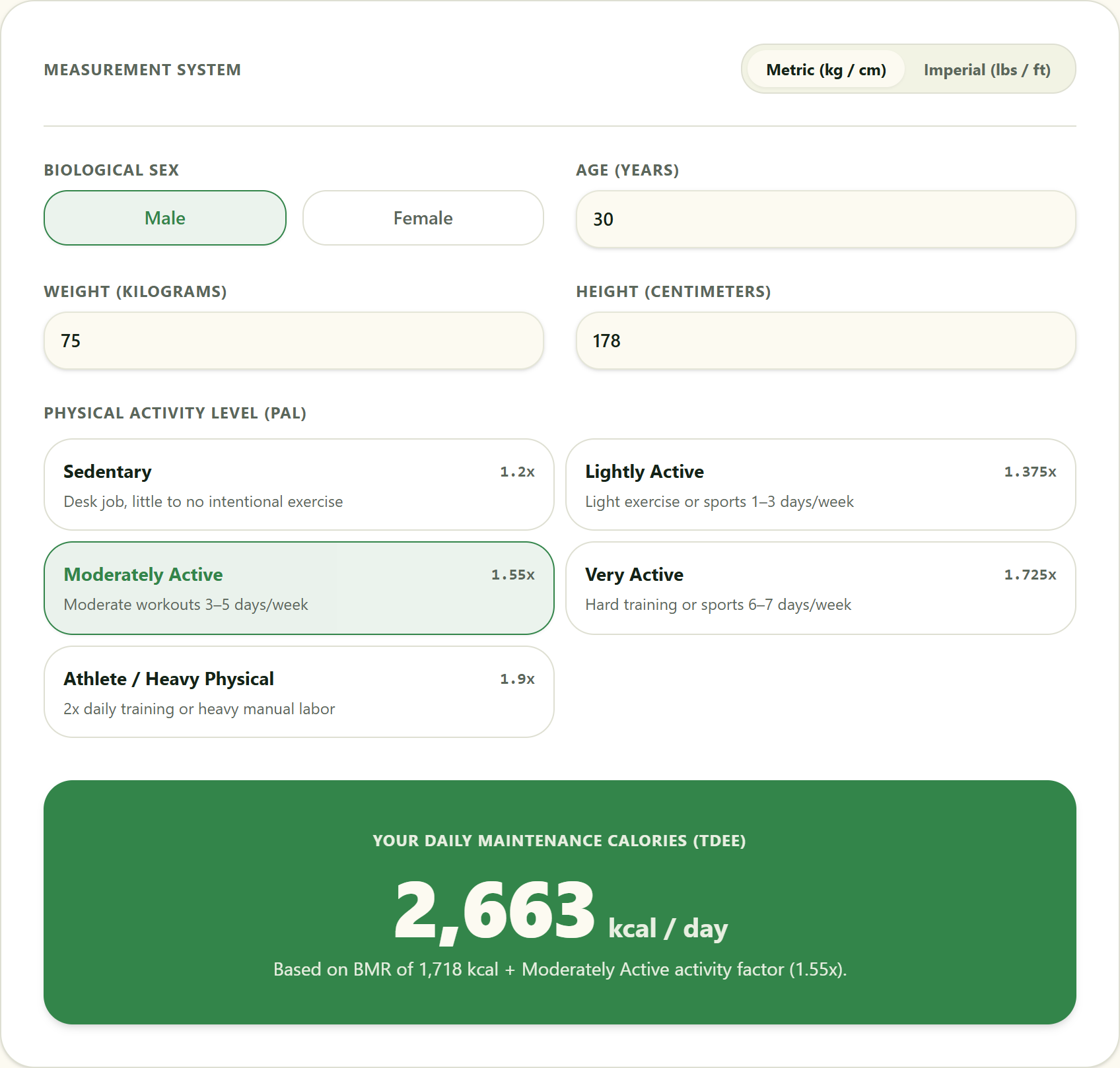
Before planning a single recipe, open our interactive TDEE Calculator and enter your biological sex, age, current weight, and height. Our engine uses the validated Mifflin-St Jeor formula to determine your baseline resting expenditure (which you can also check via our standalone BMR Calculator).
Next, choose your Physical Activity Level (PAL). A common meal prep mistake is overestimating activity. If you work a seated office job and perform 45 minutes of resistance training 3 days a week, select 'Lightly Active' (PAL 1.375) rather than 'Very Active'. Selecting an overly aggressive multiplier will inflate your portion sizes and stall fat loss progress.
3. Step 2: Set Your Goal Target with a Safe Deficit or Surplus
Once your maintenance TDEE is computed, adjust the daily number according to your primary objective:
1. Fat Reduction: Subtract a sustainable 300 to 500 kcal per day (a 15% to 20% deficit). You can model the exact timeline on our Calorie Deficit Calculator.
2. Weight Maintenance: Use your exact maintenance TDEE as your daily batch-cooking ceiling.
3. Muscle Building: Add a conservative 250 to 350 kcal daily surplus to support resistance training recovery while minimizing excess fat accumulation.
For example, if your maintenance TDEE is 2,400 kcal and your goal is gradual fat reduction, your daily meal prep target is 1,900 kcal.
4. Step 3: Translate Daily Targets into Weekly Batch Portions
The secret to stress-free batch cooking is multiplying your daily macro and caloric quotas across the entire week before stepping into the kitchen:
Take your daily target (e.g. 1,900 kcal) and multiply by 7 days to get your weekly energy requirement: 13,300 kcal. Using our Macro Calculator, divide this total across your daily meals (e.g., 3 meals + 1 snack daily):
| Meal Slot | Calorie Target | Target Protein (g) | Target Carbs (g) | Target Fats (g) | Batch Cook Container Strategy |
|---|---|---|---|---|---|
| Breakfast (Meal 1) | 450 kcal | 35g | 45g | 14g | Overnight oats jar with chia & whey protein |
| Lunch (Meal 2) | 550 kcal | 45g | 55g | 16g | Glass container: Grilled chicken, brown rice, broccoli |
| Dinner (Meal 3) | 600 kcal | 50g | 50g | 20g | Glass container: Lean beef or lentils, roasted potato, greens |
| Afternoon Snack | 300 kcal | 20g | 30g | 10g | Greek yogurt or cottage cheese with almonds & berries |
| Daily Total | 1,900 kcal | 150g | 180g | 60g | 4 pre-portioned containers per day |
5. Step 4: Batch Cook, Weigh, and Divide Systematically
To assemble your containers with pinpoint nutritional accuracy:
1. Weigh dry ingredients prior to cooking (e.g., 700g dry jasmine rice for 7 lunches and dinners).
2. Cook bulk protein, starch, and vegetables in large sheet pans or multi-cookers.
3. Place your empty meal container on a digital kitchen scale, tare it to zero, and spoon in the calculated raw-equivalent cooked weight.
4. Label each container with the date prepared and meal slot number.
6. Step 5: Don't Forget Daily Hydration and Automated Scheduling
A high-protein, high-fiber meal prep routine increases metabolic water turnover. Ensure you maintain optimal cellular hydration by running your activity metrics through our Daily Water Intake Calculator.
If you prefer to have all the math, ingredient weights, and localized grocery lists generated automatically in seconds, try our Free AI Meal Plan Generator. It takes your biometrics, calculates your TDEE, and formats a complete 7-day printable prep schedule tailored to your regional ingredients.
You can verify all formulas, thermic effect constants, and activity coefficients anytime on our Calculation Methodology page.
Frequently Asked Questions
How many days in advance should I prep my meals?
Cooked lean meats, fish, grains, and roasted vegetables stay fresh in sealed airtight containers in the refrigerator for 3 to 4 days. For a 7-day schedule, batch cook on Sunday afternoon for Monday through Wednesday, and do a quick 30-minute top-up cook on Wednesday evening for Thursday through Saturday.
Should I weigh my meal prep ingredients cooked or raw?
Raw weights are always the most accurate because water loss during cooking varies based on cooking time, heat intensity, and method. If using cooked weights, use standard cooked-to-raw conversion tables.
How often should I recalculate my TDEE as my weight changes?
Recalculate your TDEE every 3 to 4 weeks or after every 2 to 3 kg change in body weight. As your body mass shifts, your resting energy baseline changes, requiring minor adjustments to container portion sizes.
Scientific Evidence & References
- Energy Expenditure Evaluation and Physical Activity Multipliers in Dietary Planning — American Journal of Clinical Nutrition, 84(4), 857–864[View Source ]
- Behavioral and Nutritional Strategies in Long-Term Meal Preparation Adherence — Journal of the Academy of Nutrition and Dietetics, 117(9), 1435–1443[View Source ]
Generate Your Custom 7-Day Plan
Apply these principles to your local groceries, budget, cuisine, and fitness goal in seconds.
Open 7-Day Meal Generator